
"Some things cannot be fixed. They can only be carried." ~Megan Devine
Dear Clients, Colleagues, Associates, Friends and Family,
I finished a coaching engagement recently with someone I'll call John.
John came to me with a career conundrum. Forty-one years old, married at twenty-three to the love of his life and his best friend, he had just lost the marketing communications job he'd held for fifteen years at a large company. He couldn't find his way back into the field. His neighbor, knowing he was bilingual in Spanish, asked if he'd tutor her kids. One family led to another, and within a few months a small tutoring company had hired him — not for much money, but enough to keep the lights on. He discovered, to his own surprise, that he was good at it. That he even loved it. And now he was stuck between three doors: loyalty to the small company that had thrown him a lifeline, the pull to strike out and build his own tutoring business, which he suspected could actually make him real money, and a full-time return to marketing communications, the field he'd spent fifteen years in.
Somewhere in our first sessions, almost in passing, John had also mentioned that he was in the middle of a separation, heading toward a divorce, after twenty years of marriage. He didn't want to talk about it. He wanted to talk about the career decision. So we talked about the career decision — for months. And month after month, he didn't move. He'd come back, session after session, seemingly working hard and engaged, but somehow the needle simply would not shift.
In our last scheduled session together, the rest of the story came out. John had recently discovered he was gay. That was the real reason behind the separation — not a betrayal, not a falling out of love, but the ground underneath his entire marriage was turning out to be different than the one he thought he was standing on.
He hadn't talked about it to anyone. He hadn't looked at it. He hadn't, in any real sense, let himself feel what discovering that he was gay had done to twenty years of his own story.
But what does a career decision have to do with any of that?
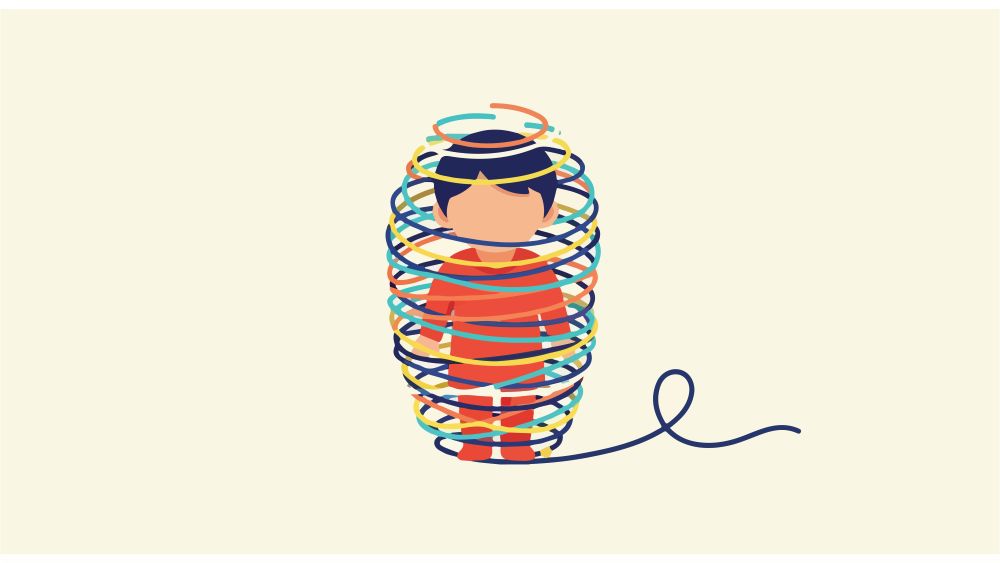
Here's what I think was going on. John wasn't stuck on a career decision. He was stuck because he hadn't grieved. Not grieved a death. Grieved the loss of the man he thought he was, the marriage he thought he was living, the future he'd been building toward for twenty years — without ever fully unpacking what it meant that it wasn't going to happen the way he'd assumed. He was so preoccupied — every ounce of his emotional bandwidth requisitioned by a loss he hadn't named as a loss — that there was nothing left over for him to make a career decision.
There rarely is-- anything leftover--when grief goes unacknowledged.

I wrote a newsletter back in 2021 called With Great Love Comes Great Pain, also about grief, in the wake of the tenth anniversary of my husband Steve's death. That piece was more about the grief of death specifically. John's story is what convinced me to come back to this topic and widen the lens, because grief, it turns out, doesn't only have to do with whether someone died.
Grief is the emotion that shows up whenever something ends.
Since working with John, I've noticed a lot of different loss experiences around me.

A young woman in my family just came home from a year abroad. New country, new friends, a version of herself she'd grown into over twelve months. I watched her this morning, literally closing the door on the room she'd lived in for the last year — turning the last page of a chapter she loved, and she wasn't remotely ready to finish.
Two young couples close to me just had their first babies. If you've had children yourself, you know the feeling underneath the joy that almost nobody warns you about: grieving the life you had before. The independence. The freedom to do exactly as you pleased, answerable to no one.


And then there's the friend who spent a decade as a successful surgeon, married someone whose career took them across the world, and became, overnight, an expat spouse — no job, no title, no operating room, in a country where he didn't yet speak the language. He lost his profession and his culture in the same move.
None of these are deaths. But all of them involve grief — even though nothing about them fits what we've collectively agreed grief is supposed to look like. We tend to reserve real grief for what we've decided are “real” losses and rank everything “smaller” as not worth the name. Mark Twain refused that ranking. He wrote this line in a piece of fiction called "Which Was the Dream?" — published the year after his own daughter died:
"Nothing that grieves us can be called little; by the external laws of proportion a child's loss of a doll and a king's loss of a crown are events of the same size."
Two leading grief scholars have given names to experiences like these. Kenneth Doka calls it disenfranchised grief — grief arising from a loss that is not openly acknowledged, socially validated or publicly mourned because the culture has not agreed that it counts. Job loss, divorce, estrangement, profound shifts in identity, even the loss of a pet: all of it qualifies, all of it real, none of it gets a funeral.
Pauline Boss describes a related experience as ambiguous loss — the loss that has no clean edge, no confirmed ending, nothing to point to and say "there, that's what happened." As she puts it: "With ambiguous loss, there's really no possibility of closure." Grief doesn't resolve, in these cases. It gets carried.

This is close to the theme running through Fleetwood Mac's "Landslide" — watching yourself get older, and being handed a mirror you didn't expect, showing someone you're not sure you recognize yet. The song doesn't resolve that fear, it just names it.
Where's your own landslide moment? The one where you caught your reflection and didn't recognize the person looking back — and never quite let yourself grieve who you used to be before you could become whoever's standing there now?
I’ve come to think that there are two very different ways of moving through grief.
Passive grief is the default strategy. It happens whether you engage with it or not — it runs on its own schedule, shaped by circumstance, by your support system, by how much practice you've had grieving before. There's no fixed timeline for it, and no shame in it either. But passive grief, left entirely alone, tends to simmer underneath everything. Life still gets ground out day by day. Yet there's an undercurrent that doesn't lift even on the good days. C.S. Lewis described it this way:

"Grief is like a long valley, a winding valley where any bend may reveal a totally new landscape."
Proactive grief is the alternative. It means turning toward the loss on purpose instead of waiting for it to keep showing up disguised as something else. This is close to what researchers Stroebe and Schut call the dual process model of grief — the idea that healthy grieving isn't one steady march forward, but an oscillation between facing the loss directly and stepping back into ordinary life. What I'm calling proactive grief is really just making sure the loss-facing side of that oscillation actually happens, instead of getting skipped indefinitely. That's what my coaching client John never did. He thought he was trying to solve a career problem. In reality, he was avoiding a grief problem.
Mary Oliver's poem "In Blackwater Woods" gets at this better than I can-- that to live in this world requires learning to love fully, to hold on with everything you have, and still, eventually, to let go. It's the closest thing I know to a philosophy of grief in eighteen lines:
To live in this world
you must be able
to do three things:
to love what is mortal;
to hold itAgainst your bones knowing
your own life depends on it;
and, when the time comes to let it go,
to let it go.
The whole arc lives in those three verbs — loving something fully, holding onto it as if your life depends on it, and releasing it anyway when the moment comes. Letting go here doesn't mean severing the bond — it means releasing the fight against what's true. You're allowed to keep him, keep her, keep it close. You're just not allowed to keep pretending nothing has changed.
Anne Lamott describes what's left once you've actually lived through that arc: you don't get over a loss so much as you learn to live alongside it: "You learn to dance with the limp."
John's limp, in the end, was a marriage he'd never properly said goodbye to, and a self he hadn't yet learned to recognize. He didn't need a new career strategy. He needed permission to grieve the man he used to be.
Loss doesn't knock before it arrives, and it rarely shows up looking like what it actually is. John called his loss an inconvenient timing problem. Most of us do some version of the same thing — we rename the loss, so it looks like a logistics issue instead of a wound, because a logistics issue is something we're equipped to fix, while grief, so often, is not. The renaming process happens because it's easier to feel capable than to feel powerless in front of something you can't solve your way out of. An un-mourned loss doesn't go away because we've declined to look at it. It moves into the walls of the house and waits there instead.
So ask yourself: is there a loss that you haven't mourned yet? Is there a loss that you might have filed away as "a career problem," or "just how life is now," or "not a big deal"? What is its real name?
If you’d like somewhere to begin, I’ve created a Grief Practice Worksheet you can download:
Warmly,
Pascale | The Challenge Coach
P.S. If you would like to go deeper on any of this, here are a few resources:
- Jennifer Senior’s Pulitzer Prize–winning Atlantic article, now published in book form as On Grief — on what grief does to people over years, not weeks
- Kenneth Doka’s work on disenfranchised grief, for a deeper understanding of why some losses receive less recognition and support than others
- Pauline Boss's Ambiguous Loss: Learning to Live with Unresolved Grief, if your loss is the kind with no clear edge to it
- Megan Devine's It's OK That You're Not OK — the book this newsletter's opening quote comes from.