
A quick note before we begin:
I hesitated about how to open this newsletter.
If you’ve been reading me for a while, you already know this about me: I don’t pretend that life is neat, predictable, or fair. I work with real people facing real lives — and those lives are often messy, frightening, heartbreaking, or simply overwhelming.
Still, I don’t want to repeat myself. And I don’t want to depress you.
So let me say this simply: lately — for me, for many of my clients, and judging by the wider world, for a lot of people — life is and has been a LOT.
When things pile up, when fear or grief or exhaustion take over, it becomes surprisingly hard to do the very things we know help us. Our nervous systems hijack the show, our thinking narrows and we forget our good habits.
And yet, over the years — through my own life, my work with clients, and my training — I’ve collected a set of very practical tools that help me and others stay more regulated, more grounded, more human in the face of hardship.
I call them life hacks.
Not because they are shortcuts or magic tricks — they’re not — but because they are simple, learnable practices that make life more workable if we remember to use them. And that “if” matters. Because the hardest part is not knowing these tools. The hardest part is remembering them when we need them most.
That’s what this newsletter is about.
How to use this newsletter
This is not something you need to read straight through. Think of it as a toolbox.
You can jump to what feels most relevant to you right now:
I. Staying present and not getting overwhelmed
II. Emotional regulation of the nervous system
III. Using the body to influence the mind
IV. Gaining emotional distance and perspective
V. Shifting mindset and inner orientation
VI. Communicating without triggering defense
You might bookmark a version of this newsletter from my website. You might come back to it. You might practice just one of these for a while. That’s more than enough and can make all the difference in the world.
Some of these techniques are practices that are best rehearsed daily so that they become automatic habits we reach for in a moment of upheaval. Some are mantras. Some are concepts. What they all have in common is that they are proven techniques which can literally change the course of a moment and help you survive a crisis.
I. Staying Present & Not Getting Overwhelmed by Life
1. “Cross that bridge when you get to it”
Worrying about things that haven’t happened yet steals energy from the present. Most imagined catastrophes never occur — and those that do are rarely exactly as imagined. You don’t need to solve everything today. This hack is a mantra to remember to refuse to solve future problems prematurely. Wait until you are actually standing in front of the proverbial “bridge” before trying to cross it. Deal with what is real now, not what might be.
Example: You notice yourself spiraling about a worrisome medical appointment next month. You catch it, name it (“this hasn’t happened yet”), and bring your attention back to what actually needs doing today — like finishing the PowerPoint presentation due tomorrow morning.
2. Parking issues (compartmentalizing)
When you are facing multiple problems, see if you can sort and separate them from each other. Then decide which one is actually in front of you and must get solved now. That one gets attention. The others get “parked” — assigned to a later time or date. Literally in your calendar. This prevents everything from collapsing into one overwhelming mental pile while also giving you reassurance that you won’t forget to get back to the other ones.
Example: You list three worries: a friend who didn’t sound good on the phone last night, your accountant’s email about taxes due in April, and the strange noise in the attic. You decide which one truly needs attention now (checking in on your friend today) and schedule the others for later.
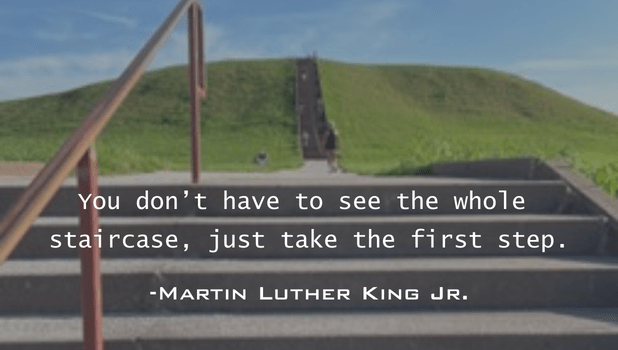
3. One step at a time
How do you eat an elephant? One bite at a time.
How do you climb a mountain? One step at a time.
When you stare at the summit, discouragement sets in and paralysis follows. Progress happens by narrowing the focus: what is the next right step? Not the tenth, not the final outcome — the next. So instead of looking at the whole mountain, look at your feet. Put one foot in front of the other in the direction you want to go.
Example: Instead of planning an entire strategic planning process for your board, you focus only on the next doable step — reading the three consultant proposals you received.
4. “This too shall pass”
Almost nothing is permanent. Change is not optional — it is inevitable. And in some cases that’s great news. This doesn’t minimize suffering or pretend things are easy. It simply reminds us that no emotional or situational state lasts forever, even when it feels endless. Holding this perspective by repeating this mantra when the going gets rough can prevent despair from hardening into hopelessness.
Example: In the middle of a sleepless night when everything feels heavy and endless, you repeat this phrase to yourself to remember that this moment, however painful, is not permanent.
5. “When [I do X], then I will [do Y].” (pre-programming the brain)
When in crisis, the thinking brain shuts down and we get frazzled and forgetful, thus adding insult (forgetting things) to injury (the crisis at hand). The brain remembers best when we give it a cue that’s stacked on something else we know we will do, ideally an automatic daily habit. “When I put my shoes on, I will grab the doctor’s orders.” “When I open my laptop, I will check my calendar.” This simple structure helps automate behavior and reduces mental load, especially under stress.
II. Emotional Regulation of the Nervous System
6. Shake it off like a dog

Animals instinctively discharge stress through movement. A full-body shake — from head to toe— helps release tension and reset the nervous system. You can even add blowing bubbles through pursed lips to deepen the calming/reset effect. This sounds—and looks, and even feels—really silly. But practiced regularly (preferably in private!), this becomes a quick but incredibly powerful reset tool in moments of stress. I challenge you not to become addicted to this one! It’s one of my most recently discovered hacks but truly a life changing one.
Example: After a tense phone call or meeting, you step into your bedroom or bathroom, close the door, and shake your whole body a few times to release pent-up tension.
7. Breathing — but not the way everyone says
Different stress states need different breaths. We have all heard about what I call the “F” mode of the brain when we get triggered and go into survival mode: Fight, Flight or Freeze. And we have all heard that to calm down, we need to “take deep breaths”.
However, these “F” modes are not all the same and require different solutions. In fight-or-flight (high/nervous energy), long slow exhales help calm the system. In freeze (low/paralyzed energy), short, quicker inhales help restore movement and energy. The key is matching the breath to the state, rather than using one technique for everything.
Example: If you’re wired, agitated, or snappy, you focus on long, slow exhales. If you feel frozen, numb, or unable to start, you take a few quicker inhales to bring energy back online.
8. Riding the waves of emotion
Emotions rise and fall like waves and are unavoidable natural human reactions to life events. The work is not to suppress them, but to notice when we become emotional and to decide not to fight the waves. Instead, we can choose to stay present (i.e. “surf the wave of emotions”) as things run their course. Tools like RAIN (Recognize, Allow, Investigate, Nurture) from Tara Brach, or brief grounding practices (see hacks 6 or 7 above), help us move through emotions without being swept away.
Example: Instead of suppressing tears or anger during a difficult moment, you pause, breathe, and let the feeling move through you — trusting that the emotional wave will crest and subside.
III. Using the Body (somatics) to Influence the Mind

9. Zip up (somatic protection)
Zipping up an invisible protective cloak can help establish powerful emotional boundaries. This can be done in the morning for full-day protection or discreetly in a moment when we feel emotionally triggered or attacked. It reminds the body that it can stay engaged without absorbing everything around it and helps us feel safer and more assured in our day to day.
Check this video from Donna Eden to find out how exactly how to do it.
10. Put a smile on your face

Believe it or not, the faces we make send powerful signals to the brain. We can actually create emotional states inside our bodies by putting the mask of these emotions on our faces. Putting a smile on: softening the jaw, lifting the corners of the mouth, relaxing the eyes — even briefly — will shift our internal state. This isn’t about pretending everything is fine; it’s about deliberately choosing the state you bring into a moment, especially before difficult interactions.
11. Chin up (posture matters)
Beyond our facial expressions, our minds also believe our body posture: how we hold our bodies affects how we feel and think. So for a successful outcome, put on your warrior pose: standing tall, opening the chest, grounding the feet can foster confidence and steadiness. Before an important conversation or decision, adjust your posture first — it often changes what follows.

Example: Before entering a meeting or making a tough phone call, you stand tall, open your chest, ground your feet, and notice how your inner state shifts.
12. Act as if
This is not a modern coaching trick. It comes straight from Alfred Adler, who spoke about “acting as if” as a way humans grow into new capacities before they feel ready. Long before today’s language of visualization, goal-setting, or intention, Adler understood something essential: we don’t become confident and then act — we act, and confidence follows.
“Acting as if” does not mean pretending, faking, or lying to yourself. It means moving your body and your behavior in the direction of a future state you desire, even when you don’t yet feel legitimate, competent, or secure there. It is about embodying — in action — who you are becoming.
Think of the first time someone teaches a class they have just finished learning themselves. Or the first time a medical professional performs a procedure they have only studied and observed until that moment. At some point, knowledge must turn into movement. There is always a first time when we act the part before we fully feel it inside.
This life hack invites you to take small, concrete actions that align with who you want to become — not once you’re certain, but because you’re not. Movement teaches the nervous system that the future state is survivable, possible, and real. In other words: belief doesn’t come first. Action does.
IV. Emotional Awareness & Perspective Shifts

13. Name it to tame it.
You can’t work with what you can’t name, or as Albert Einstein said “you can’t solve a problem from the level of consciousness that created it”. This technique is a mnemonic device to call to mind when trying to solve problems. Identifying what you’re actually feeling or facing creates distance and choice. Clarity and awareness are the first steps out of reactivity and into problem solving.
Example: You catch yourself snapping at your partner about something trivial and pause long enough to realize, I’m not actually angry — I’m exhausted and anxious about an upcoming deadline. Or you notice yourself feeling restless and on edge all day and finally name what’s underneath: I’m scared because I’m waiting for medical test results. In both cases, naming the real emotion reduces the swirl and immediately changes how you respond — to others and to yourself.
14. Dissociation vs. association
When revisiting difficult situations, try viewing those little mind movies as an external observer rather than reliving them from inside as an active participant in the scene. This shift reduces emotional charge and allows insight and compassion to emerge, without denying what happened. This in turn allows you to really learn from past experiences and do better the next time.
Example: After a difficult interaction, you notice yourself replaying the scene over and over, feeling the same tightness and frustration each time. Instead of reliving it from inside your own eyes, you intentionally imagine watching the scene from the outside — as if it were a movie. You see both people, notice tone, body language, and context. Creating that distance softens the emotional charge and allows you to understand what happened without being pulled back into the intensity of it.
V. Meaning, Mindset & Inner Orientation
15. "Do you want to be right or do you want to be love?"
This question is meant to be spoken out loud by one of the two people in the middle of an argument — said gently, with awareness, and addressed directly to the person they are arguing with. It is a rhetorical question and not a weapon. It only works in a relationship where both people have previously agreed that this phrase can be used as a respectful signal to interrupt a power struggle.
When used that way, it can immediately slow things down and shift the tone of the exchange. Holding tightly to being “right” often blocks connection. Choosing love doesn’t mean abandoning your values — it means, in that moment, prioritizing understanding and relationship over winning the argument.
16. Gratitude practice
I call this daily practice “the brushing of the teeth of the soul.”
Each night, before going to sleep, take a moment to name three specific things that happened that day for which you feel grateful. Those can be general blessings or concrete moments.
This simple practice gently retrains the mind away from constant threat-scanning or negative focus and toward noticing what is working and nourishing. Over time, it shifts how life is experienced — not by denying hardship, but by restoring balance. Rooted in Positive Psychology, it is one of the most reliably life-changing practices there is.
Example: At the end of the day, you think back over the last 24 hours and identify three specific moments you’re grateful for: the appointment that went better than expected, the friend who checked in by text, and the fact that you finally slept a little better last night.
VI. Communication Hacks (Relational Intelligence)
17. "If I were you…” instead of “you should”
The word “you” naturally triggers reactivity and defensiveness in others; or at the very least it triggers the instant reflex of putting ourselves in a position of responding (instead of fully listening). Speaking from our own perspective by using “I” phrases keeps conversations open, flowing and collaborative, rather than adversarial.
Example: Instead of telling someone what to do, you share how you might approach the situation if you were in their place. Instead of “You should talk to your boss about this,” you say, “If I were in your position, I might ask for a one-on-one meeting and explain how the workload is affecting me.” The shift keeps the other person open and listening, rather than defensive.
18. No Name No Blame No Shame
Naming a problem to tame it has to be done in a very specific way for this technique to be productive. When problems are framed as people’s faults, solutions stall. When framed as shared challenges or patterns, problem-solving becomes possible. This shift keeps nervous systems online and conversations productive.
Example: Rather than accusing someone of being the problem, you describe the issue as a shared challenge that needs addressing: Instead of saying, “You’re always late and it’s disrespectful,” you say, “We keep having trouble starting meetings on time, and it’s affecting how the group functions. How can we address that?” By focusing on the problem rather than the person, the conversation stays constructive and solvable.
A Closing Thought
January often comes with pressure to reinvent ourselves. I’m not interested in resolutions. I believe “re-solutions” are more impactful: I am interested in habits that sustain us — especially when life doesn’t cooperate.
In fact, I believe we all need these tools.
Not because we are broken, but because we are human — living in a world that is increasingly fast, reactive, polarized, and unforgiving. Learning how to regulate ourselves, pause, think, and respond rather than react is not a luxury or a personal preference; it is a responsibility. To ourselves, to the people we love, and to the communities we live in.
Practicing these life hacks is not about becoming perfectly calm or endlessly serene. It is about doing the ongoing work of becoming steadier, more conscious, more accountable human beings — especially when emotions run high and the stakes are real. The more practiced we are, the more likely we are to slow down, choose wisely, and act with care rather than impulse.
You—and I: we ALL need something solid to reach for when the ground shifts.
That’s what practice gives us.
If you want support...
If you’re reading this and realizing you don’t quite have these tools yet — or that you’ve forgotten how to use them — reach out. This is the work I do every day with individuals and groups.
You may also want to join my small coaching group, Courage to Change, starting February 5 (see below). It’s designed for people navigating transitions, uncertainty, or overload, as well as for those who want to strengthen their inner footing before things get hard.
I hope this has been encouraging — a reminder that there are many small, practical tools you can call on when life feels overwhelming. These life hacks matter. Pick one now and start practicing it. The more regulated and conscious we become, the more we contribute — to our own lives, to our families and communities, and to this world that needs us to show up as the most grounded version of ourselves we can be.
Happy practicing!! Let me know how it goes. I love hearing success stories.
The Challenge Coach
There is a moment that happens in almost every group I lead: someone speaks a truth they’ve been carrying alone—grief, fear, overwhelm. And then someone else in the circle realizes: “I feel that too.” Something shifts. The isolation cracks, and you can almost hear the exhale. This is the power of being witnessed.
So many of us think we have to be strong alone, when real courage often begins in the moment, we let ourselves be seen. That’s why I created Courage to Change—a small, 4-week coaching group for people navigating profound turning points.
This is not a group to fix your life or tell you what to do. It is to sit with you as you find what’s still true, still strong, still possible.
People often tell me after the first session: “I didn’t know I was this strong.”
If you’re longing for a space where you can find that truth again… I hope you’ll join us.
PROGRAM DETAILS
🗓️ Format: 4 weeks · 75 minutes per session · Live on Zoom
👥 Group Size: Max 10 participants
🌅 Start Date: Thursday, February 5, 2026 · 12:00–1:15 PM ET