
Every morning somewhere around 7am I drive by my supermarket on the way back from the gym. There is a homeless man sitting at the light, on the ground. He is this little pile of grey— all his clothes are grey, from his shoes to his hat. He only gets up and moves between the cars when the weather is warm enough to try for a few donations.
I have known him for a while. He is always there and has been for months. Back in September, he was sitting there with a little boy. As I often do, I lowered my window to chat with him. He explained that it was his youngest grandson — he was SO proud. School was starting again the next day. I asked the little boy if he was excited about going to school, but he was too busy chewing on his beef jerky to answer.
We’ve had a polar vortex since December here in Maryland, and a massive snow and ice storm at the beginning of January dumped a foot of snow that at the time of this writing, still hadn’t melted because the temperatures stayed so low.
“My” guy has been sitting in a pile of plowed, dirty, grey snow that’s about three feet high for weeks. He is there every morning, curled into himself.
A few days ago, it had been 3 degrees overnight (not a typo! A record in Maryland…). The wind was whipping hard. Ungodly conditions. When I drove by him that morning, my heart dropped more than usual. I could not understand how anyone could be sent back outside under those conditions. I’m sure there are rules. I’m sure there are reasons. But that morning none of them felt reasonable.
I turned around, went to get hot coffee and a few hot sandwiches, and brought them back.
When I approached him, he slowly lifted his face toward me. He had a bloody nose. His skin was blue. There were icicles in his beard. Clearly, his brain was frozen because it took him a while to understand what was happening. Obviously, his body was frozen too and it took him forever to stretch his arms out to receive the coffee and food.

As I drove away, heartbroken and sobbing, this question came to me:
WHAT IS REALLY IMPORTANT?
That moment has not left me. And gradually I understood that this question had already been circling me for weeks.
A dear family member fell deathly ill in January, in France. They have since been diagnosed with a serious disease. Should I carve out the time and the budget to go see them? I have so much work. So many commitments. So little flexibility. How would that even be reasonable?
Then again: what is really important here?
A few days ago, I stumbled across a post on social media from someone I don’t know. He wrote about trying to work while his wife faces yet another round of cancer. He described staring at his computer screen, unable to produce anything, and asked strangers how they manage to function when hardships hit, and life still demands productivity.
It would have been easy to scroll past. Instead, I stopped and spent time crafting a thoughtful response. I might not know this man, but he is a fellow human being facing something unimaginably hard — something I know all too well. Who would I be to just scroll on?
What really matter in that moment?
Not long ago I was getting ready for a very full day — important presentations, tight timing, no room for delays — when one of my children Face Timed me at an unusual hour. My instinct told me to answer. Great call: the kid in question was having a complete meltdown over an avalanche of nasty problems. I had to take a breath and decide whether to protect my schedule or to get fully present.
That question again: what was really important?
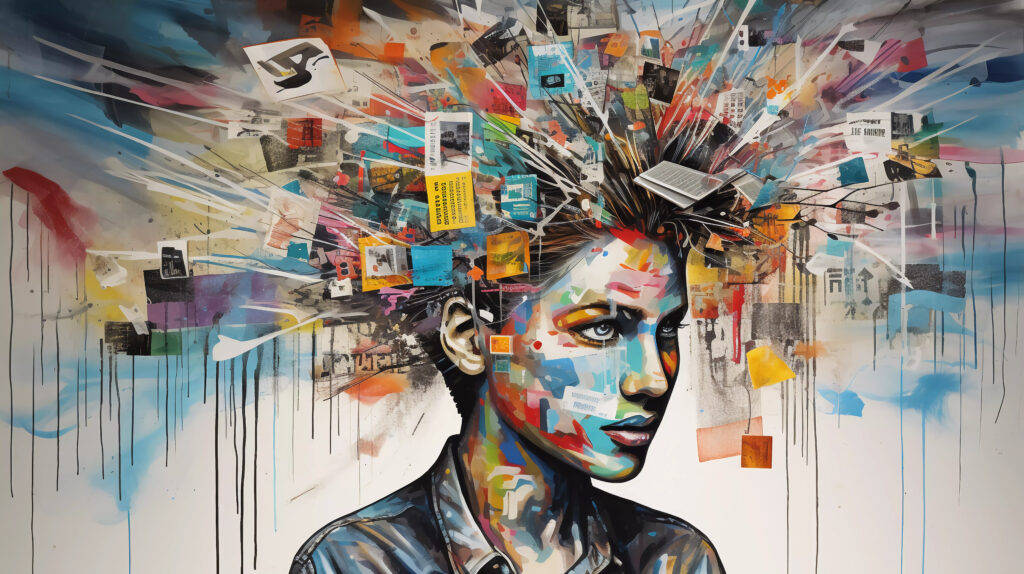
This is a question I use often in coaching sessions, even just today. When someone is caught in the brouhaha of their own thoughts — overwhelmed, pressured, convinced that everything must be handled immediately — this question has a way of cutting through the noise and bringing perspective back.
But there is more to it than that. Because when life gets loud, everything can feel urgent. And urgent is not the same thing as important.
“What is really important?” did not arise in a vacuum. It came in the wake of very concrete moments — a man sitting in a snowbank with icicles in his beard, a cancer diagnosis across an ocean, a stranger’s plea for help, a child’s voice breaking through a screen.
None of those moments were abstract. They were physical, immediate, human. And yet what struck me most was not only what was happening around me, but what was happening inside me.
Each time, something tightened. My thoughts sped up. Responsibilities lined up in my mind like dominoes. I felt the pull of all the things I was supposed to be doing. And at the same time, I felt the tug of something else that did not fit neatly into a calendar.
When life destabilizes us — whether through tragedy, shock, moral outrage, or simply emotional intensity — our system mobilizes. That mobilization is intelligent. It is designed to help us respond. The difficulty is that once activated, we often lose perspective. Everything starts to feel equally pressing. We cannot easily distinguish between what is central and what is peripheral.
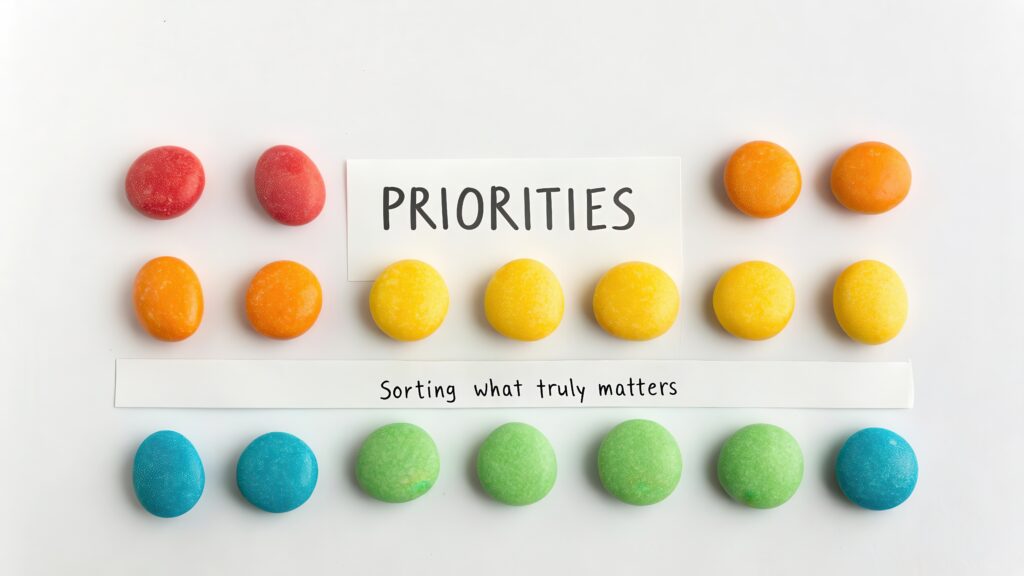
I see this in coaching constantly. Someone arrives convinced that ten issues require immediate attention. As we slow down and look carefully, it becomes clear that one issue sits at the center and the others orbit around it. But in the heat of activation, they all feel as if they carry the same level of priority. This is where the question becomes powerful.
Not because it is philosophical, but because it forces hierarchy.
“What is really important here?” requires us to pause long enough to sort signal from noise.
And that pause is not trivial. It is regulatory. When we slow down — even briefly — the part of us capable of perspective comes back online. We regain access to nuance. We can consider consequences. We can weigh values instead of merely reacting to pressure.
That is the psychological layer.
But there is also a relational one.

Very often, when we ask what is truly important, the answer has something to do with connection. With presence. With contribution. With how our actions affect other human beings.
This is where Adler’s concept of social interest quietly enters the room. He proposed that psychological health is inseparable from our sense of belonging and usefulness within the larger human community. We are not meant to function as isolated productivity units. We are embedded in relationships, and our decisions reverberate through them.
When I wondered whether I should make time to visit a sick family member, the tension was not only logistical. It was existential. What kind of person am I orienting myself to be? When I chose to answer a stranger’s plea instead of scrolling past, I was not solving his life. I was responding to our shared humanity. When I paused for my child instead of protecting my schedule, I was choosing relationship over efficiency — at least in that moment.

None of those choices eliminate responsibility. Deadlines still exist. Work still matters. The point is not to romanticize love over structure. The point is to allow our structure to be guided by values rather than by reflex.

In Adlerian terms, we are always moving toward imagined goals. We strive to be competent, significant, secure. We also strive to belong and to contribute. When we are overwhelmed, our private logic — the early conclusions we formed about how to survive and succeed — can take over. We default to “I must handle everything,” or “I must not disappoint,” or “I must stay in control.” Under stress, those old rules get louder.
The question “What is really important?” interrupts that automatic script.
It invites us to step back and ask not only what demands attention, but what deserves it.
And often, once we have calmed enough to see clearly, the answer simplifies things. Not because life becomes easy, but because our orientation becomes clearer. We may still have many tasks, but we know which one carries weight. We may still feel stretched, but we understand why we are choosing what we are choosing.
Clarity does not remove pain. It reduces chaos.
And living deliberately — rather than reactively — is a skill. It can be practiced.