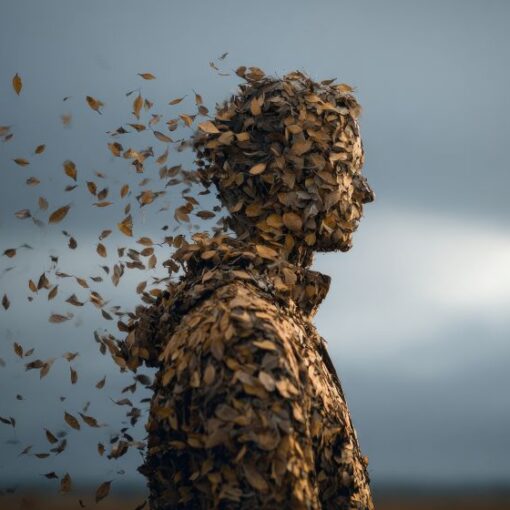

I had coffee recently with a man I’ll call Jean-Pierre. A gentle soul, freshly retired, someone whose life has been full of meaning and contribution. Now that he finally has space — real, uncluttered space — to turn toward the projects he has always dreamed of, you would think he’d be flying out of bed with excitement.
But that isn’t what happens.
Most mornings, Jean-Pierre lingers under the covers far longer than he intends. He reaches for his phone, scrolls through the news, reads an article, then another. The morning light shifts; time softens around the edges. He tells himself he’s “easing into the day,” but noon arrives before he has touched the work that matters to him. And by late afternoon, he feels that quiet sting — not of laziness, but of self-disappointment.
Jean-Pierre is not a man who lacks discipline or motivation. He is not lazy, and neither are you. He is simply up against something deeper, older, more universal. Something I recognize in so many of us — and, if I’m honest, in myself too.
This is procrastination. And it hurts.
The Real Pain of Procrastination
Let’s speak honestly, because procrastination always comes with a very particular flavor of suffering:
- The self-betrayal (“I promised myself today would be different.”)
- The guilt (“I have so much to do. Why can’t I just do it?”)
- The shame (“What is wrong with me? Other people seem to manage.”)
- The anxiety (“The more I avoid it, the bigger it gets.”)
- And the quiet erosion of self-trust.
You know this pain. Most of us know it. It’s universal, deeply human, and far more common than we admit.
That’s why the composer John Cage’s small but powerful invitation is so liberating:
It sounds almost too simple — until you realize that beginning somewhere is everything.
So, let’s answer the question so many people whisper to me in coaching sessions:
Why do I do this to myself? It makes NO sense.
Actually — it makes perfect sense.
What Procrastination Really Is
1. Your brain is an energy Scrooge — because its first job is to keep you alive.
This is not a metaphor; you guessed it: it’s neuroscience.
The brain represents only about 2% of your body weight, but consumes 20–25% of your total energy, even when you’re sitting still. Evolutionarily, that was extremely costly. So the brain developed a brilliant survival strategy:
Conserve energy for anything that might be needed for survival.
The way it conserves energy is through habits. Habits require almost no metabolic fuel. They bypass the slow, effortful prefrontal cortex and slip into the automatic circuitry of the basal ganglia. In other words:
Habit is the brain’s energy-saving mode.
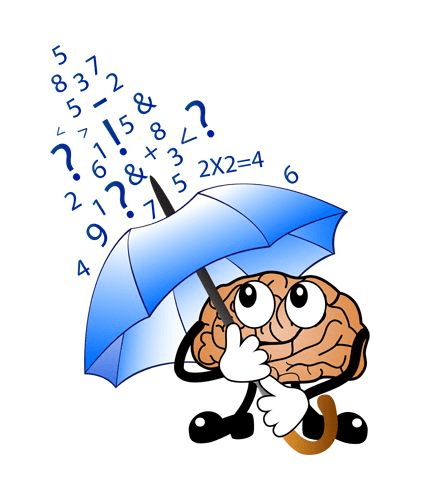
This means that even “bad” habits — the scrolling, the snacking, the lingering in bed, the postponing — are neurobiologically easier than anything new.
New things require more effort, more energy, more potential risk. To your brain, the familiar is pleasure. Not because it feels good —though sometimes it does— but because it’s easy, automatic and comfortably predictable. Trying something new —even if it’s tiny, even if it’s good for you— requires more energy. The brain resists it the way you resist jumping into a cold lake. There’s nothing wrong with the lake. You just don’t want the shock.
Your brain fights the new thing, not because you’re weak, but because it’s doing its job: protecting you, rather earnestly, like a slightly outdated but well-meaning bodyguard.
So: you are not broken! There is nothing wrong with you. You’re human — with a brain exquisitely wired to prefer the familiar.
2. Procrastination is also about pain avoidance.
We put things off because tasks often stir up difficult inner reactions, such as:
- Fear of success (yes, that’s real).
- Fear of exposure.
- Fear of not being good enough.
- Overwhelm.
- Perfectionism.
- Confusion about where to start.
- Or simply: “This is unpleasant and I don’t want to.”
The brain’s pain/pleasure system is ancient and extremely primitive. Its mandate is simple:
Avoid discomfort. Seek comfort through habit. Repeat.
Rabindranath Tagore said it bluntly:
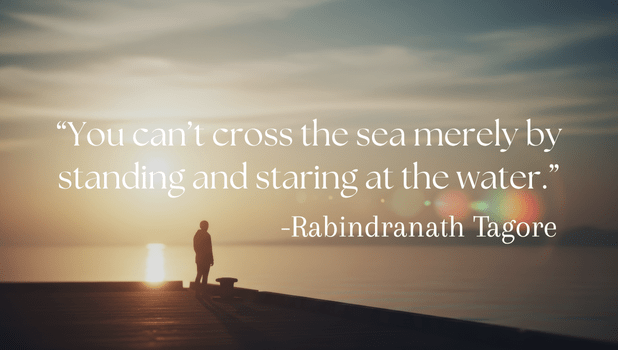
And yet — how many of us stare at the water for years?
3. We procrastinate because change is uncomfortable — until it becomes unbearable.
This is the quiet emotional underbelly.
We stay in the wrong job, the wrong city, the wrong habits, the wrong relationship—long after we know better—because habit feels safe. Even when it hurts.
We change only when the pain of staying becomes sharper than the pain of moving.
Anaïs Nin captured this perfectly:
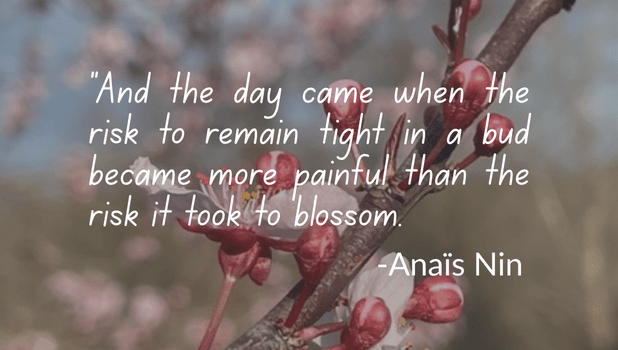
Your suffering is not a failure: it’s often a signal. A sign that you’re outgrowing something.
So… How Do We Break Procrastination?
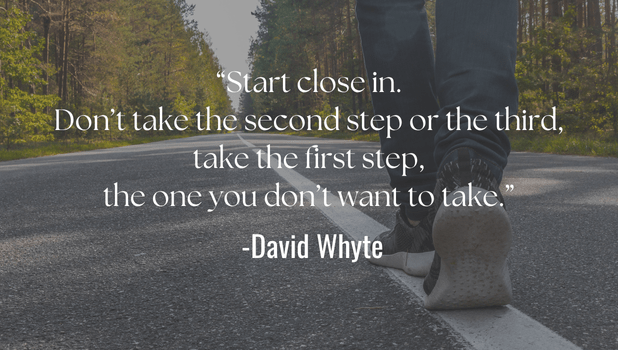
There are a thousand tiny tools, but they boil down to two essential bookends — the Two-Prong Solution:
THE TWO-PRONG SOLUTION TO PROCRASTINATION
1. Reduce the Resistance
Your brain is resisting because it anticipates discomfort. So we begin—gently.
We make the beginning as small, easy, light, and painless as possible.
A Ta-Da List (instead of a To-Do List)
A To-Do list often feels like judgment.
A Ta-Da list celebrates every small step — with dopamine.
Write down what you did, not what you should do.
- Open the laptop — Ta-da!
- Write one sentence — Ta-da!
- Take a walk — Ta-da!
Tiny dopamine bursts retrain your brain to associate action with pleasure instead of fear.
Micro-starts
If the task feels overwhelming, break it down until it no longer feels threatening.
- Not “write the chapter.” Just “open the document.”
- Not “start my business.”Just “send one email.”
- Not “declutter the garage.” Just “open the door.”
Once you start, the resistance softens. Momentum is everything. Once you start, your brain relaxes and action begets action.
Design for ease
- Put your shoes by the bed.
- Stage the project the night before.
- Put your phone in another room.
We are not weak: we are human. Design beats willpower every time.
2. Move Toward Something That Matters
Reduction of resistance isn’t enough. We also need something that pulls us forward.
The “deathbed clarity” exercise
I sometimes ask clients:
“At the end of your life, what would you regret not having done?”
That question rearranges priorities fast.
Suddenly the writing matters.
The conversation matters.
The health matters.
The creativity matters.
The courage matters.
Identity overrides motivation
Instead of “I need to write,”
try: “I am someone who writes.”
Instead of “I should exercise,”
try: “I am someone who cares for my body.”
We rise to the level of who we believe we are.
Partner with your future self
Imagine the future you whispering:
“Thank you for doing the uncomfortable thing so I could live this life.”
That voice can move mountains.
Putting It All Together
Over time, something real begins to shift.
Procrastination doesn’t vanish in a blaze of motivation; it softens the way seasons change — gradually, then almost all at once. You take one small step, then another, and these small steps create a rhythm. Action becomes less fraught, more possible.
And please hold this close: there is nothing wrong with you. You’re not lacking willpower. You are simply working with a brain that loves the familiar and a heart that longs for meaning. Those two parts of you sometimes tug in different directions — but both are on your side.
Procrastination isn’t a character flaw. It’s simply the space between the life you’re in now and the life that’s trying to emerge. That gap is bridgeable — with compassion, tiny steps, and a vision worthy of you.
As Mary Oliver asks in The Summer Day, a question that belongs at the very heart of this conversation:
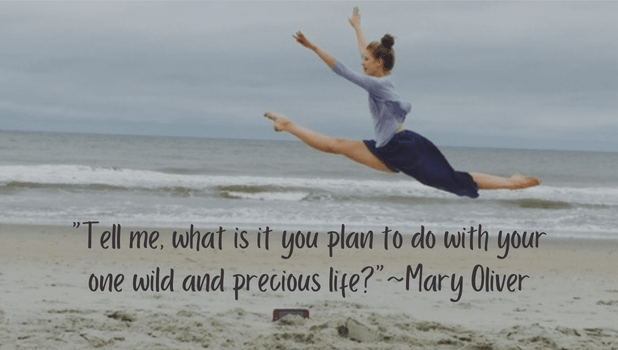
So … what do YOU want to not leave “Unwritten” ?

The Challenge Coach

FEATURED EVENT
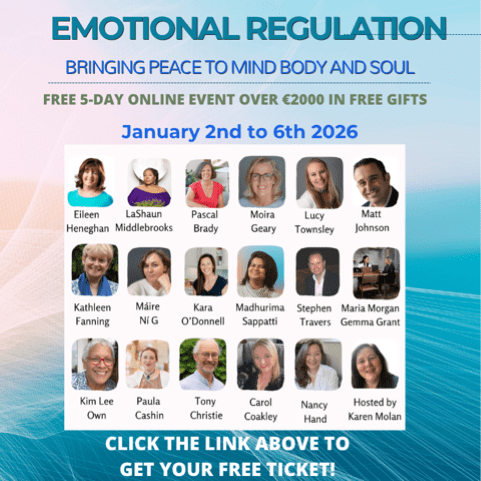
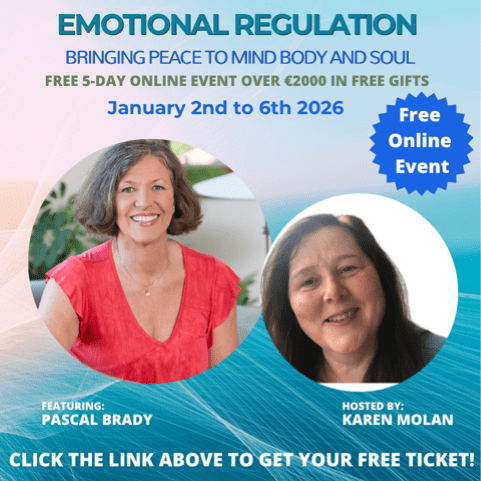
EMOTIONAL REGULATION SUMMIT
Bringing Peace to Mind, Body, and Soul
Kick off 2026 with clarity, calm, and connection. My friend Karen Molan has brought together 18 top wellness experts from different fields for this free 5-day online summit on Emotional Regulation. Along with the 17 other experts, I will be sharing practical strategies to help you manage stress, deepen relationships, and reclaim your energy.
What to Expect:
- 18+ expert interviews and trainings
- Topics spanning neuroscience, coaching, energy work, and emotional mastery
- Guests include ICF Coach of the Year Kathleen Fanning, Havening expert Stephen Travers, and more
- Practical tools to help you manage stress, deepen relationships, and align your goals with your values
🗓️ Dates: January 2-6, 2026
🕒 Format: Daily expert sessions
💻 Location: Online — attend from anywhere
🎟️ Cost: Free with registration

COMING IN FEBRUARY —
COURAGE TO CHANGE
A Coaching Group for Life’s Turning Points
When life shifts—through loss, illness, relocation, separation, or quiet reinvention—it can feel like standing at the edge of a bridge, unsure of the next step. Courage to Change is a small-group coaching experience designed to help you move forward with clarity, strength, and support.
Led by Pascale Brady, PCC — The Challenge Coach, this live Zoom series offers a safe, compassionate space to explore what’s next. Whether you’re in the midst of upheaval or sensing a quiet call to change, you’ll be guided to reconnect with your inner compass and take meaningful steps toward renewal.
PROGRAM DETAILS
🗓️ Format: 4 weeks · 75 minutes per session · Live on Zoom
👥 Group Size: Max 12 participants
🌅 Start Date: Thursday, February 5, 2026 · 12:00–1:15 PM ET